The second phase of simulation modeling took place within the framework of the activities of the Council on Cognitive De-occupation of Crimea, which operates based on the Mission. The event was attended by experts from various fields, including representatives of the state and civil society, military personnel, journalists, educators, historians, and psychologists, as well as experts on security, community resilience, and cohesion.
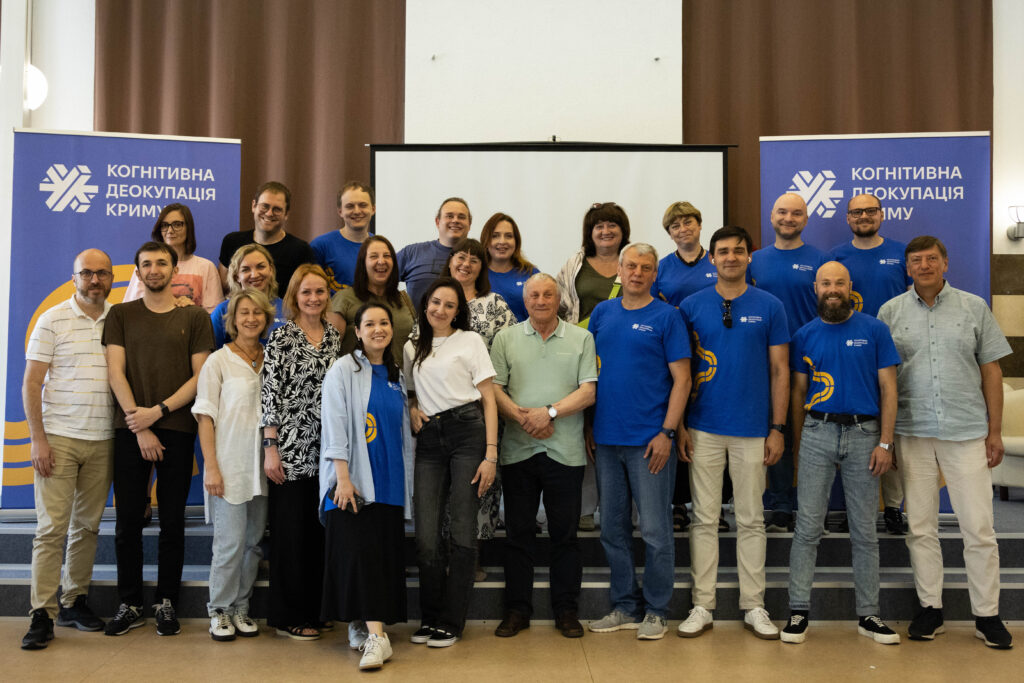
The simulation modeling was based on specific scenario games, during which experts developed practical solutions and steps for government agencies, the expert community, civil society, and international support programs. These initiatives aim to actively develop initiatives and activities within the framework of the Strategy for Cognitive De-occupation of Crimea.
As Denys Chystikov, Deputy Permanent Representative, noted at the beginning of the exercise, cognitive de-occupation is a strategic component of the reintegration process of the peninsula. It is based on communication and psychological work in political, humanitarian, and social areas, accompanying and strengthening reintegration policies in various fields.
According to Yevhen Bondarenko, Head of the Information Support Department of the Mission, the continued influence of Russian propaganda and the conditions of occupation on the population of Crimea are expected to create significant risks and obstacles to the reintegration process after the liberation of the peninsula.
The three-day event was held in the format of a game, simulating the work of consulting groups trying to compete in processes related to the implementation of cognitive de-occupation. The teams had the opportunity to influence each other’s actions and react to internal and external events and factors in various areas. The experts spent time analyzing the game process as a tool for working with representatives of the government, local administration, and the expert community.
According to Dmytro Teperyk, an international expert on resilience and security, testing different de-occupation scenarios and analyzing the reactions of different groups allows for a better understanding of the mechanisms needed to overcome the difficulties of preparing and implementing the Strategy of Cognitive De-occupation. This also helps explain the strategy in simple terms to the population of Ukraine. He stated,
“It is a matter of returning to the Ukrainian and European value systems of the behavioral attitudes of people who have suffered from a long authoritarian occupation.”
Based on the results of the simulation modeling, the experts identified risks and possible consequences that should receive more attention in the process of cognitive de-occupation. They also identified necessary regulatory changes that will allow the state and non-governmental sectors to work more effectively in implementing the Strategy of Cognitive De-occupation of Crimea.
Yuliia Tyshchenko, an expert on social cohesion, believes that an important result was that the participants identified necessary steps to be taken in the legal, informational, and educational spheres in the Ukrainian-controlled territory even before the kinetic de-occupation of the peninsula. She emphasized that the reintegration process is bidirectional.
This event is supported by the Partnership Fund for a Resilient Ukraine (PFRU), funded by aid from the governments of Canada, Finland, Netherlands, Sweden, Switzerland, the United Kingdom, and the United States.