The discussion was attended by Andrii Sybiga, representative of the Ministry of Foreign Affairs; Tamila Tasheva, Permanent Representative of the President of Ukraine in the Autonomous Republic of Crimea; Martin Harris, Ambassador of the United Kingdom; Refat Chubarov, Chairman of the Mejlis of the Crimean Tatar People; and Artem Kyselov, a serviceman from Crimea and former deputy commander of the Pryluky missile boat.
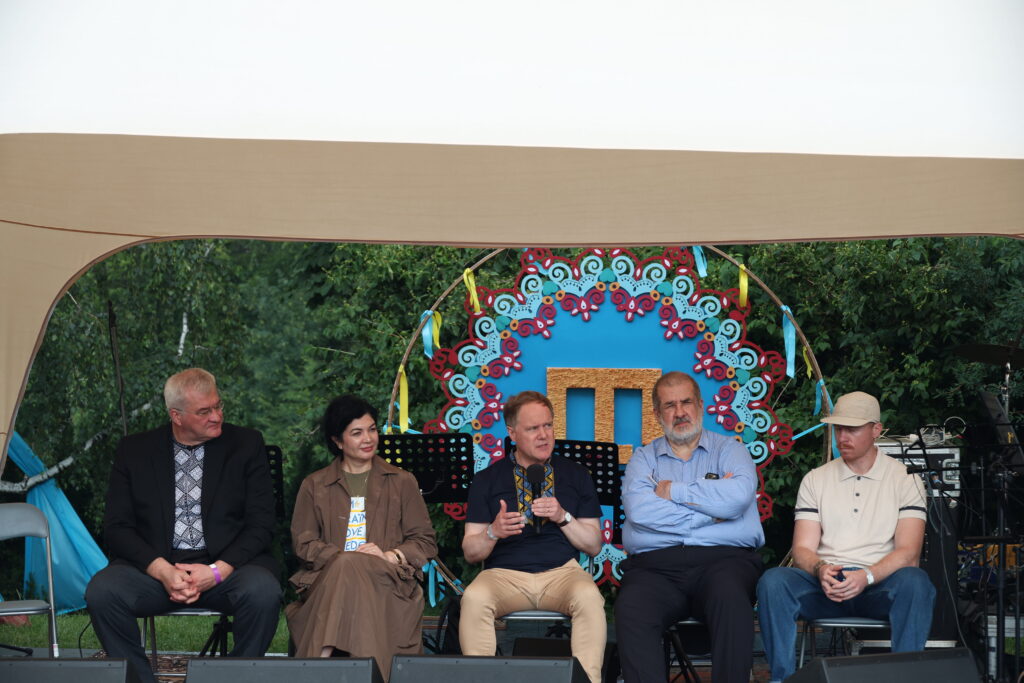
The discussion was moderated by Maria Tomak, Head of the Crimea Platform’s Support Service.
After introductory remarks, Andrii Sybiga emphasized the importance of the thesis that peace is impossible without the liberation of Crimea and that there is no alternative to the de-occupation of the peninsula.
The Permanent Representative stressed the importance of working with the expectations of the people and showing that there is a vision of a liberated Crimea, along with a clear reintegration plan. She noted:
“Our people in Crimea are waiting for clear answers because the biggest fear is the fear of the unknown. We are working to dispel this fear and must develop strategic documents for achieving this goal. It is important to develop clear steps to know what the future authorities will look like, for example, the model of military administrations.”
Martin Harris, Ambassador of the United Kingdom to Ukraine, emphasized that Crimea is crucial for the security and future peace of the world. He noted that the war began 10 years ago with the occupation of Crimea, and the attempted annexation is a gross violation of the UN Charter. The liberation of Crimea would mean strengthening and reinforcing the UN principles for the security of Europe and the world. These issues are relevant to both Crimeans and citizens of the United Kingdom.
Refat Chubarov stressed the importance of the future of the Crimean Tatar people, who have no future outside of Ukraine. He stated that surrendering to Russia would mean allowing Russia to continue its efforts to exterminate an entire people.
Artem Kyselov, responding to a question about Crimeans in the armed forces, said that almost all his friends who left the occupied peninsula serve in the army, and many of them have died for Ukraine. He emphasized that we should not forget the first victims of Russia’s war against Ukraine, who were murdered by the occupiers in Crimea—Serhii Kokurin and Stanislav Karachevskyi.
Asked whether the Crimea Platform remains relevant in the context of the Peace Summit, First Deputy Foreign Minister Andrii Sybiga affirmed its relevance, saying that Ukraine’s successes in the Black Sea prove that the goal of liberating Crimea is not an abstract idea but an inescapable reality. He also mentioned the importance of recognizing the threat to the survival of the indigenous population and noted that at the state level, it is clearly stated that genocide took place in 1944, with efforts to have the deportation recognized as genocide globally.
At the end of the discussion, participants shared where they would like to return to in Crimea after its liberation. For example, Ambassador Martin Harris recalled the visit of a British frigate to Sevastopol and looked forward to the next visit of the British Navy to the Ukrainian fleet in Sevastopol. He was supported by other participants.
The Permanent Representative said she would like to visit her family home near Simferopol, drink her mother’s coffee, and visit Bakhchysarai, her place of power—the plateau above the Bakhchysarai Palace, where she loved to sit and look out over the ancient capital of the Khan.
The Crimean Stage program is organized with the support of the Mission of the President of Ukraine in the Autonomous Republic of Crimea/Office of the Crimean Platform, ZMINA. Human Rights Center, NGO CrimeaSOS, Ukrainian-Crimean Tatar literary project Crimean Figs / Qırım İnciri, state-owned enterprise Crimean House, TRO Media, joint initiative Crimean Front, NGO Kitap Qalesi, NGO Institute for the Development of the Crimean Tatar Language, and Musafir Restaurant.
Media partners: QIRIM.Media and Crimea Daily.