On February 7, a meeting of the Crimean Studies Winter School participants with stakeholders and experts took place at the Kyiv-Mohyla Academy. The event featured a discussion with the participation of Permanent Representative Olha Kuryshko.
Other speakers included Refat Chubarov, Chairman of the Mejlis of the Crimean Tatar People; Alim Aliev, Deputy Director of the Ukrainian Institute; Suleiman Mamutov, member of the UN Permanent Forum on Indigenous Issues (UNPFII) in Ukraine; Yuliia Tyshchenko, expert of the Council on Cognitive De-occupation of Crimea and co-founder of the National Platform for Resilience and Cohesion; and Olena Luniova, Director of Advocacy at the ZMINA Human Rights Center. The discussion was moderated by journalist and TV host Andrii Kulykov and journalist and psychologist Mavile Khalil.
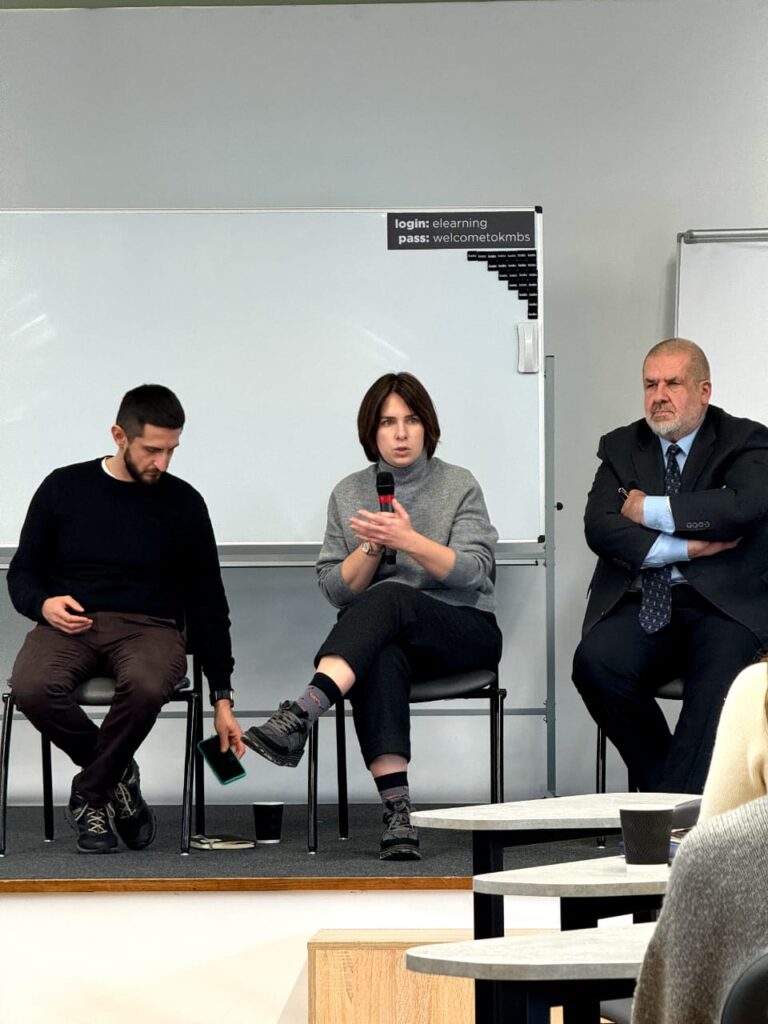
Permanent Representative Olha Kuryshko emphasized that the Mission is the only government body that was forced to relocate after the occupation, but never ceased its operations. She highlighted that maintaining connections with people under occupation—who face pressure and repression—remains a key priority.
“For me, occupied Crimea is, above all, about its people. That is why we are constantly looking for ways to support those who remain under occupation as well as those who were forced to leave,” emphasized Olha Kuryshko.
She also highlighted that the Mission’s priorities have evolved in recent years, adapting to the changing challenges posed by the occupation. Among the key areas of work, she pointed to the development of the Crimea Economic Recovery Strategy, steps within the Cognitive De-occupation Strategy, and plans for restoring state governance and public administration in Crimea after its liberation. In particular, the Permanent Representative spoke about monitoring the situation in the temporarily occupied peninsula and documenting persecution based on ethnicity, religion, and political beliefs to hold the aggressor accountable.
“We strive to document every case of repression—against journalists, lawyers, religious figures, athletes, and activists. We share this information with international partners, even if they are not yet fully familiar with the context. However, we look for common ground—through the rights of Indigenous peoples, environmental issues, and the security situation in the Black Sea. We must do everything to keep the issue of Crimea on the agenda until the peninsula is de-occupied,” emphasized the Permanent Representative.
Yuliia Tyshchenko, an expert from the Council on Cognitive De-occupation of Crimea, shared that the Council had conducted a comprehensive sociological study on cognitive de-occupation of Crimea, commissioned by the Mission and supported by the Partnership Fund for a Resilient Ukraine. She emphasized that cognitive de-occupation is not an isolated process but an integral part of the broader strategy for liberating the peninsula, encompassing communication, memory policy, educational initiatives, and the deconstruction of imperial narratives.
“We are working under the conditions of occupation, preparing informational and social mechanisms to support the reintegration process. Simultaneously, efforts continue on developing communication messages that will serve as the foundation for transforming public discourse about Crimea,” the expert highlighted.
Deputy Director of the Ukrainian Institute, Alim Aliev, emphasized the importance of cultural and educational diplomacy in highlighting the issue of Crimea and the Crimean Tatar people on the international stage. One of the key projects in this direction is the Global Coalition of Ukrainian Studies, launched with the support of Ukraine’s First Lady, Olena Zelenska. Its goal is to unite initiatives and academic programs worldwide, fostering the development of Ukrainian and Crimean Tatar studies. The coalition aims to establish a strong academic foundation for studying Ukraine globally and to contribute to the decolonization of knowledge about Crimea.
This initiative is implemented in collaboration with the Fund of the President of Ukraine for the support of Education, Science, and Sports, the Ukrainian Institute, the Mission/Office of the Crimea Platform, the Ministry of Education and Science of Ukraine, and the Ministry of Foreign Affairs of Ukraine.
The Winter School Crimean Studies was launched by the educational and research center Crimean Studies at NaUKMA in cooperation with the Crimean civic media outlet CEMAAT and the Kyiv-Mohyla Analytical Platform. The school aims to consolidate educational, and research initiatives focused on exploring Crimea’s cultural, social, and political life. The organization of lectures and the certification program has been made possible with the support of the United Kingdom in Ukraine and close cooperation with the Mission of the President of Ukraine in the Autonomous Republic of Crimea.