Yevhen Bondarenko, Head of the Information Department of the Mission, participated in the discussion titled “Why History Has Tried to Take Crimea for Centuries: Myths and True Facts About the Peninsula.” The event was held at the Press Center of the Ukrainian Crisis Media Center as part of the project “Strengthening Information Resilience in Ukraine,” in partnership with the International Practitioners’ Partnership Network (Estonia) and supported by the European Union.
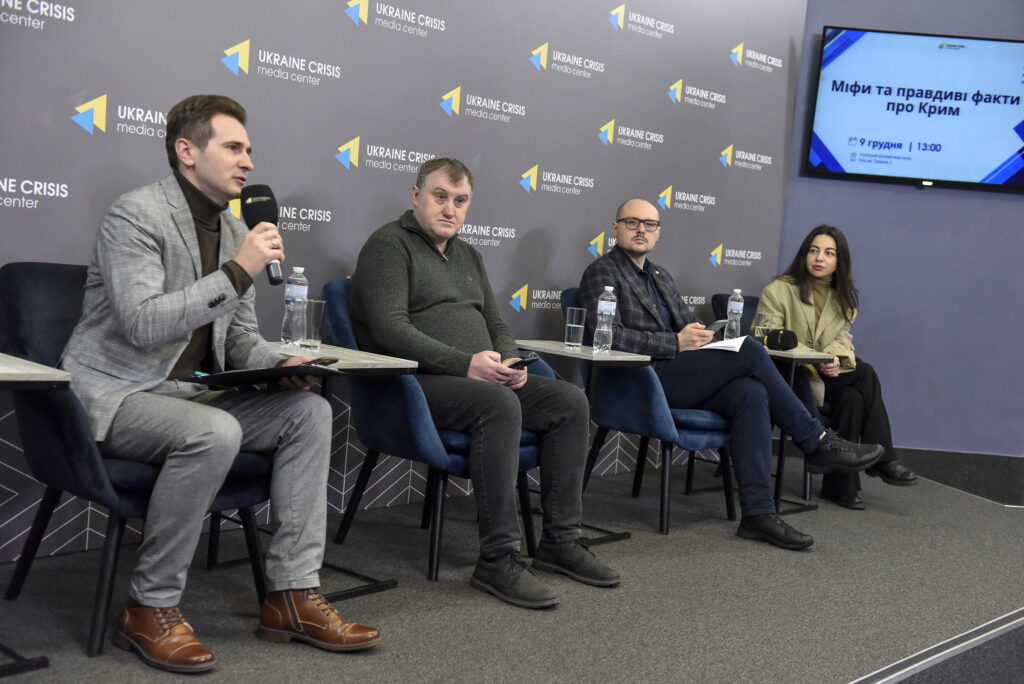
Other participants included Andrii Shchekun, a representative of the Regional Council of Ukrainians of Crimea, and Nadzhyie Ametova, a journalist with the information agency Crimean News/Qırım Media. The discussion was moderated by Ihor Stambol, Ph.D. in History and Press Center Coordinator at the Ukrainian Crisis Media Center.
Yevhen Bondarenko emphasized that the Mission and the Office of the Crimea Platform are actively engaged in debunking Russian myths about Crimea. However, he pointed out the importance of distinguishing between myths propagated by Russian propaganda and the lack of comprehensive information on various aspects of Crimea’s history. “We often overestimate Russian propaganda, assuming that certain myths are solely its invention, whereas, in many cases, it results from insufficient effort in specific areas,” Bondarenko remarked.
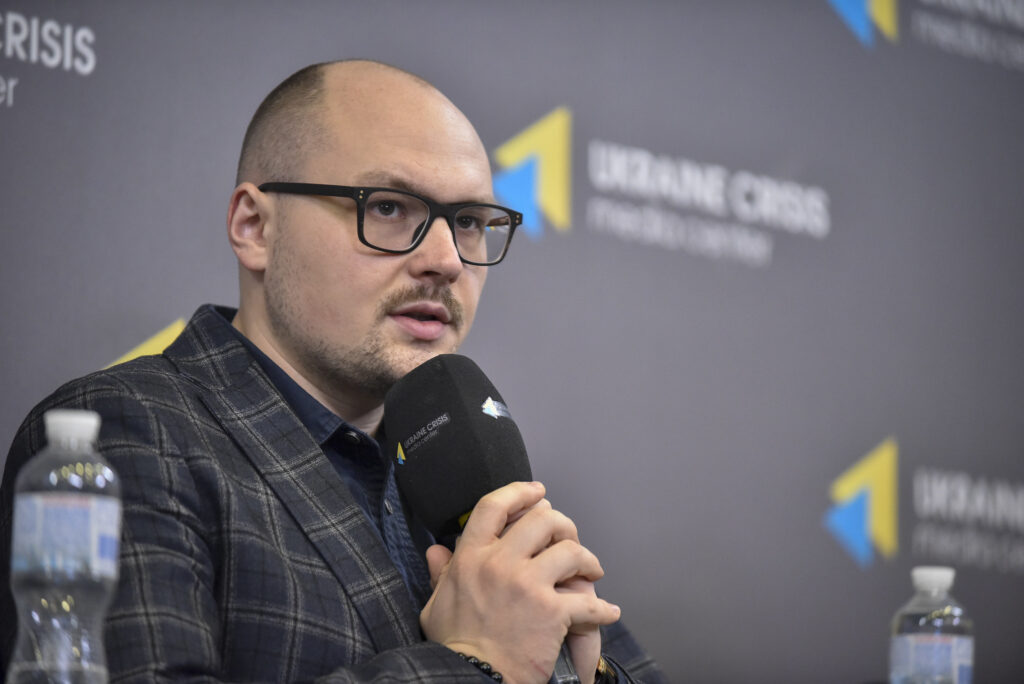
He highlighted the Mission’s regular informational activities regarding historical dates and events, often in collaboration with the Ukrainian Institute of National Memory. Over the past year, these efforts have produced more than 40 thematic materials aimed at educating the public about Crimea’s history, clarifying historical facts, and dismantling systematic myths cultivated by Russia to polarize society and spread disinformation.
“Another crucial aspect is integrating Crimea’s national memory into Ukraine’s overall national memory. When analyzing modern Ukrainian history textbooks, Crimea sometimes disappears for several centuries before reappearing. Addressing these gaps requires solid historical research and a reevaluation of Crimea’s place within Ukrainian history,” Bondarenko stated.
He also noted the Mission’s ongoing information campaigns and initiatives on national memory and the commemoration of events in Crimea, such as campaigns marking the 80th anniversary of the deportation of the Crimean Tatar people and the 10th anniversary of resistance to occupation. Bondarenko underscored the importance of communicating Crimea’s cultural and historical inseparability from Ukraine:
“We often encounter the question: Is Crimea a separate island? Crimea is not an isolated territory but an integral part of southern Ukraine and the Azov-Black Sea region. By treating the Crimean Peninsula as detached, we risk creating the perception of two separate realities,” he emphasized.
Bondarenko also highlighted the Mission’s work on cognitive de-occupation, including the activities of the Council on Cognitive De-occupation and the implementation of the Cognitive De-occupation Strategy. He stressed the significance of research conducted by the Kyiv International Institute of Sociology at the Mission’s request, noting that only 9% of respondents felt adequately informed about the Crimean Peninsula, while the majority expressed a lack of information.
“This is another focus of our efforts. We also thank all government bodies, civil society organizations, institutions, and activists contributing to this work. It is essential to advance cinema, literature, and education to strengthen this direction,” Bondarenko concluded.