At the initiative of Refat Chubarov, Chairman of the Mejlis of the Crimean Tatar People, an online coordination meeting was held to plan joint actions for upcoming memorial events organized by Ukrainian state authorities and the Mejlis of the Crimean Tatar People. Yevhen Bondarenko, Head of the Information Department, represented the Mission. More than 20 participants joined the meeting, including the leadership and representatives of the Mejlis — Head Refat Chubarov, First Deputy Chairman Nariman Dzhelyal, Deputies Riza Shevkiiev and Ilmi Umerov, as well as Akhtem Seitablaiev, Head of the Crimean House state enterprise. The meeting also brought together Crimean Tatar community activists from various regions of Ukraine and abroad, including Poland, Türkiye, the Netherlands, Germany, Lithuania, and other countries.
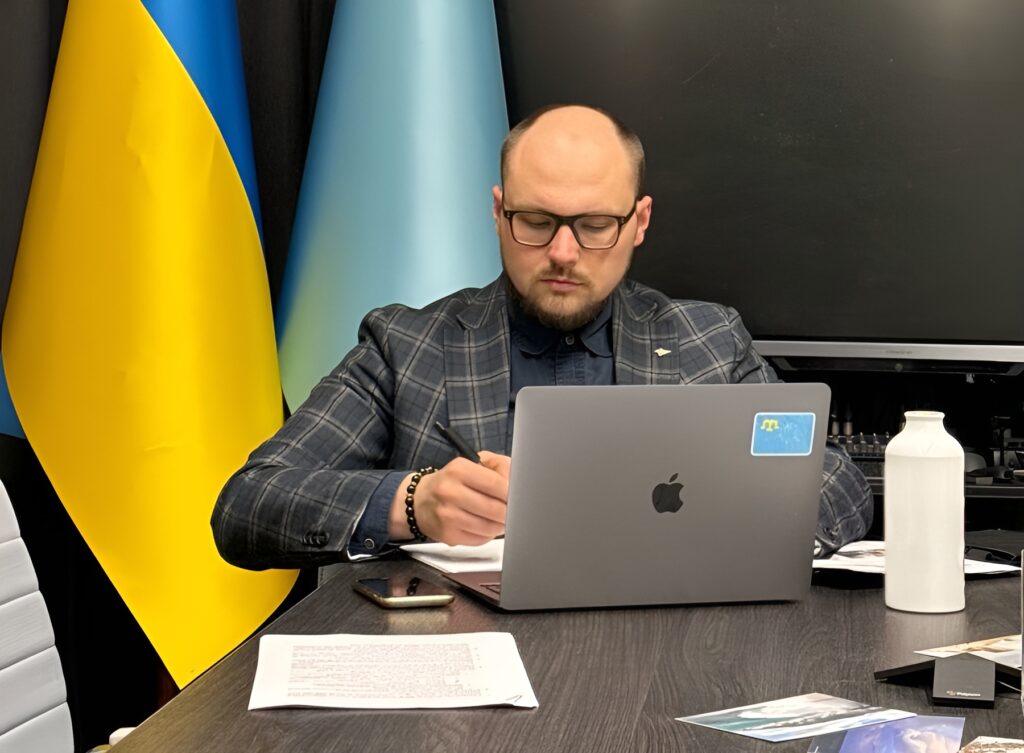
The participants of the meeting shared details of the events they are preparing for 18 May — the Day of Remembrance for the Victims of the Genocide of the Crimean Tatar People — and called for partnership in organizing and implementing them.
Yevhen Bondarenko presented the activities planned with the support of the Mission to honor the genocide victims. These include a nationwide information campaign, a public exhibition on Khreshchatyk street (in cooperation with the Ukrainian Institute of National Memory) dedicated to the history of the Crimean Tatar people, and the production of a social video spot featuring symbolic visuals for broadcasting on national television and radio.
Last year, at the initiative of the President of Ukraine Volodymyr Zelenskyy, a Memorial was opened in Kyiv. This year, it has become an important site where citizens, including members of the Indigenous Crimean Tatar people, will gather to commemorate the victims. It is important to emphasize that on 18 May, all citizens of Ukraine share in the sorrow of the tragedy committed by the Soviet regime against the Crimean Tatar people.
Special attention is given to cooperation with government agencies, regional administrations, and the Ministry of Foreign Affairs. In coordination with Ukrainian embassies, diaspora communities, and international partners, the Mission is expanding the campaign’s reach and related events abroad. Daily work continues to promote the international recognition of the 1944 deportation as an act of genocide. Across Ukrainian regions, events will be held with the participation of civil society and local authorities, who will be provided with methodological, informational, and visual materials by the Mission. Together with the Center for Crimean Studies at the National University of Kyiv-Mohyla Academy, the Mission is also preparing methodological recommendations for conducting thematic lessons in schools (elementary, middle, and high school). After 18 May, youth-focused activities will follow, aimed at preserving historical memory and passing the truth from generation to generation.
“When we speak about 18 May, we must emphasize the systemic nature of the crimes committed by Russia against the Indigenous people — during the Russian Empire, the Soviet Union, and the current Russian Federation,” noted the Head of the Information Department of the Mission. It is worth recalling that the deportation of the Crimean Tatar people in 1944 has been recognized as an act of genocide by many countries, including Ukraine, Latvia, Lithuania, Estonia, Canada, the Czech Republic, and Poland.
We are grateful to the Mejlis of the Crimean Tatar people and all participants for their coordination and cooperation.