The Council on Cognitive De-Occupation of Crimea, operating under the Mission of the President of Ukraine in the Autonomous Republic of Crimea, has initiated simulation training focusing on various aspects of the cognitive de-occupation of the population in the temporarily occupied Crimean Peninsula.
The training aims to develop practical solutions and steps for government agencies, experts, civil society, and international support programs to foster initiatives and activities within the framework of the Strategy for the Cognitive De-Occupation of Crimea.
Before the exercises commenced, Denys Chystikov, Deputy Permanent Representative of the President of Ukraine in the Autonomous Republic of Crimea emphasized that cognitive de-occupation relies on communication and psychological work across political, humanitarian, and social domains. This approach supports and strengthens various reintegration policies in areas such as education, culture, the realization of the rights of Ukraine’s indigenous peoples, youth policy, media, memory policy, decommunization, and decolonization.
Yevhen Bondarenko, Head of the Information Support Department of the Mission, highlighted that cognitive de-occupation is a strategic component of the reintegration process. It involves a coordinated combination of long-term processes influenced by numerous social, psychological, economic, cultural, and environmental factors, necessitating realistic modeling of these processes.

Social cohesion expert, and co-founder of the National Platform for Resilience and Social Cohesion, Yuliia Tyshchenko underscored the importance of building a comprehensive understanding of this process, identifying challenges, and developing approaches to synchronize, coordinate, and communicating the actions of various actors from the public and non-governmental sectors involved in this effort.
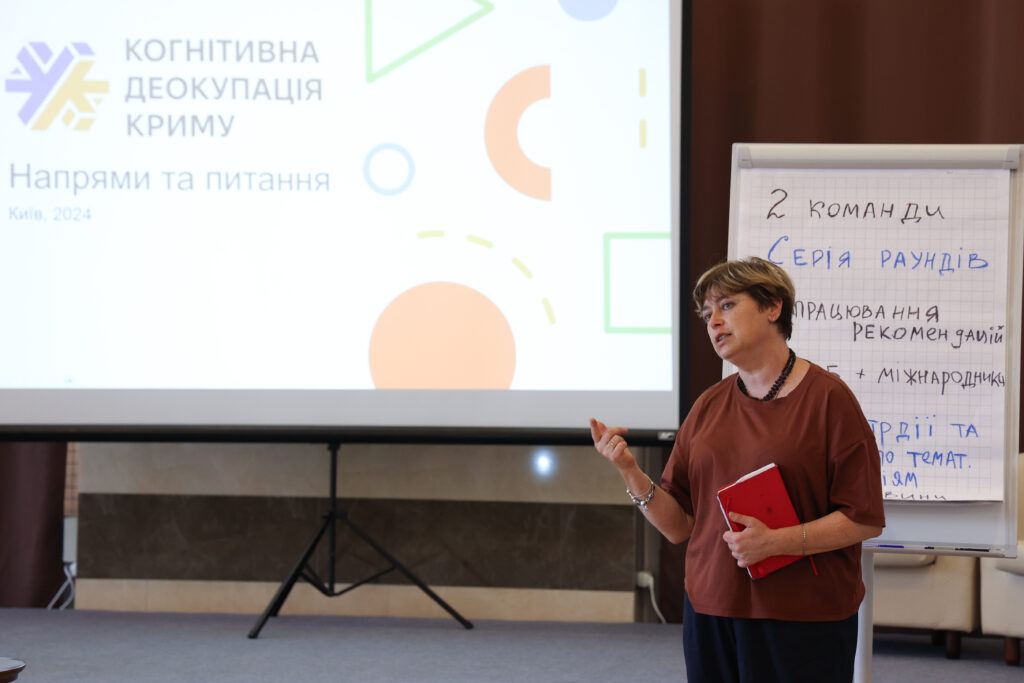
Senior Policy Expert on Societal Resilience, Disinformation, Crisis Communication, and Civil Security Dmytro Teperyk stated that active modeling of the future serves as a tool to reduce uncertainty and enhance confidence in the materialization of a fully liberated and the de-occupied Crimean Peninsula as part of a free, powerful, and democratic Ukraine.
This training is supported by the Partnership Fund for a Resilient Ukraine (PFRU).