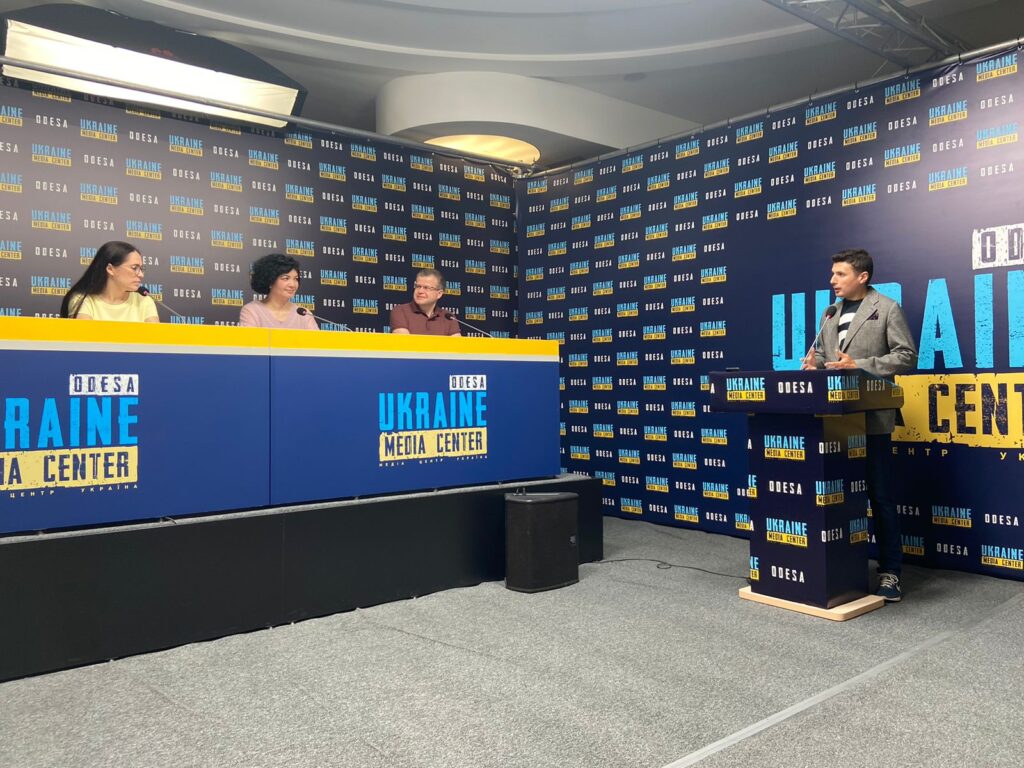
During her working visit to Odesa, Permanent Representative Tamila Tasheva took part in a press conference at the Ukraine Media Center Odesa. She was joined by Borys Kormych, Head of the Maritime and Customs Law Department of the National University “Odesa Law Academy” and Editor-in-Chief of Lex Portus magazine, and Hanna Shelest, Director of Security Programs at the Foreign Policy Council “Ukrainian Prism”.
The Permanent Representative spoke about the development of the state’s priority steps after the de-occupation of the peninsula and noted that the general provisions of these reintegration policies should apply to all de-occupied territories of Ukraine – of course, taking into account the specifics of the region. She added that these developments on the reintegration of Crimea after de-occupation will be presented on August 23 at the third summit of the Crimean Platform.
“We can already announce that on July 3, our pilot project, the “Personnel Reserve” or “Recovery Reserve”, will be launched on the basis of the National Agency for Civil Service to train public authorities in the de-occupied Crimea. We will need a lot of personnel, about 50 thousand. This includes law enforcement, judges, teachers, and medical professionals. That is why these training courses are not only for current civil servants, but for everyone,” Tamila Tasheva emphasized.
She added that within the framework of this project, two master’s programs will be launched at the Taras Shevchenko National University of Kyiv in the fall.
Hanna Shelest noted that both Odesa and the entire south of Ukraine will take an active part in the implementation of plans for the reintegration and restoration of Crimea, as this process will directly affect other regions of the northern Black Sea region.
The Permanent Representative also noted that the recovery reserve will also have to deal with cognitive de-occupation: “Our experts called it ‘cognitive demining’ because the Russians have scattered a lot of different types of mines in the minds of our citizens. That is, we will also have to deal with detoxification and demilitarization of the minds of Crimean residents who have spent almost 10 years under occupation.”
In addition, Borys Kormych noted that it will not be possible to return Crimea and its economic role to its pre-war state. In particular, the fate of the peninsula’s ports should be decided by business: “We will need maritime business expertise and vision. Some ports need to be restored, and some need to look for new formats. Like in London or Barcelona, where some port facilities have been transformed into technology parks, public spaces, etc.”