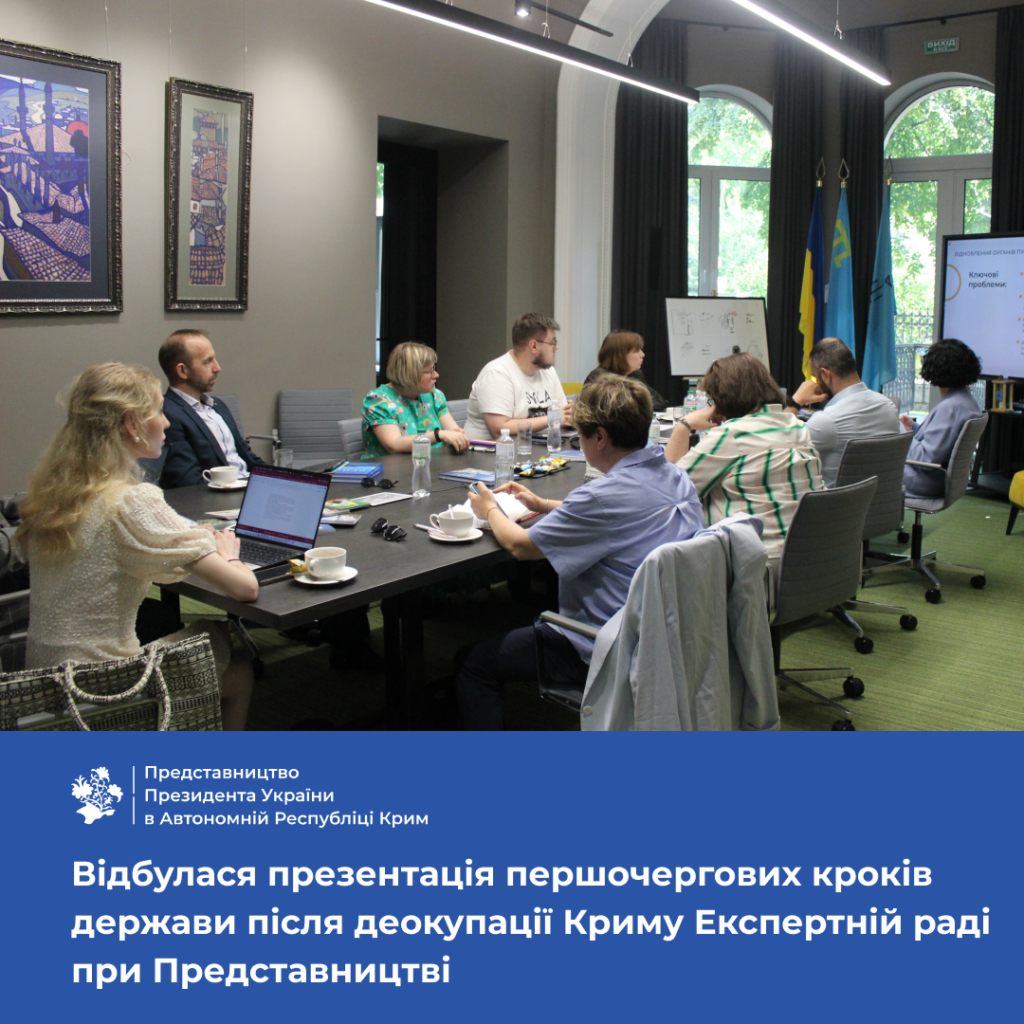
The document “De-occupied Crimea: the state’s priority steps” was presented by the Permanent Representative Tamila Tasheva, representative of the Crimean Platform expert network Daria Svyrydova, Head of the Mission’s Legal Support Department Olga Kuryshko, Head of the Mission’s Department for De-occupation and Reintegration of the Autonomous Republic of Crimea Stepan Zolotar, Press Secretary of the Mission Yevhen Bondarenko, and analyst of the National Institute for Strategic Studies Yulia Tyshchenko. The meeting was also attended by members of the Coalition “Ukraine. Five in the Morning” Coalition.
The Permanent Representative Tamila Tasheva thanked the colleagues involved in the development of the document for their productive cooperation and said that the briefs of the document of the first steps had already been presented to the Mejlis of the Crimean Tatar people, MPs, business representatives, as well as opinion leaders who come from the temporarily occupied Crimea.
Tamila Tasheva added that on behalf of the Head of the Office of the President of Ukraine Andriy Yermak, the document was sent to all central government agencies. It is also planned to present the document to diplomatic missions and the Crimean Platform’s Expert Network.
“Each of these presentations makes significant adjustments to the document and gives us a holistic understanding of what exactly will happen in Crimea after de-occupation. It is also very important that certain steps have already been reflected in the adopted legal acts, even in the educational programs of the Taras Shevchenko National University of Kyiv,” said Aliona Lunyova, Advocacy Director of the ZMINA Human Rights Center.
The Permanent Representative informed that the master’s degree programs developed at the initiative of the Mission to prepare the recovery reserve are in great demand right now, before the start of the academic year. The meeting also discussed the recently presented Strategy of Cognitive De-occupation of Crimea.
The participants discussed in detail each of the areas of the document: restoration of public authorities, verification of occupation documents, humanitarian policy, property rights, responsibility for occupation crimes, expulsion of Russian citizens who illegally arrived on the peninsula during the occupation. Ms. Lunyova noted that the greatest interest of international partners and citizens in the temporarily occupied territories is the issue of accountability for the crimes of occupation, lustration and amnesty.
The Mission thanks its colleagues for participating in today’s presentation “De-occupied Crimea: Priority Steps of the State”. This document will form the basis for the development of future policies for the reintegration of the Crimean peninsula – and today we are one step closer to this.