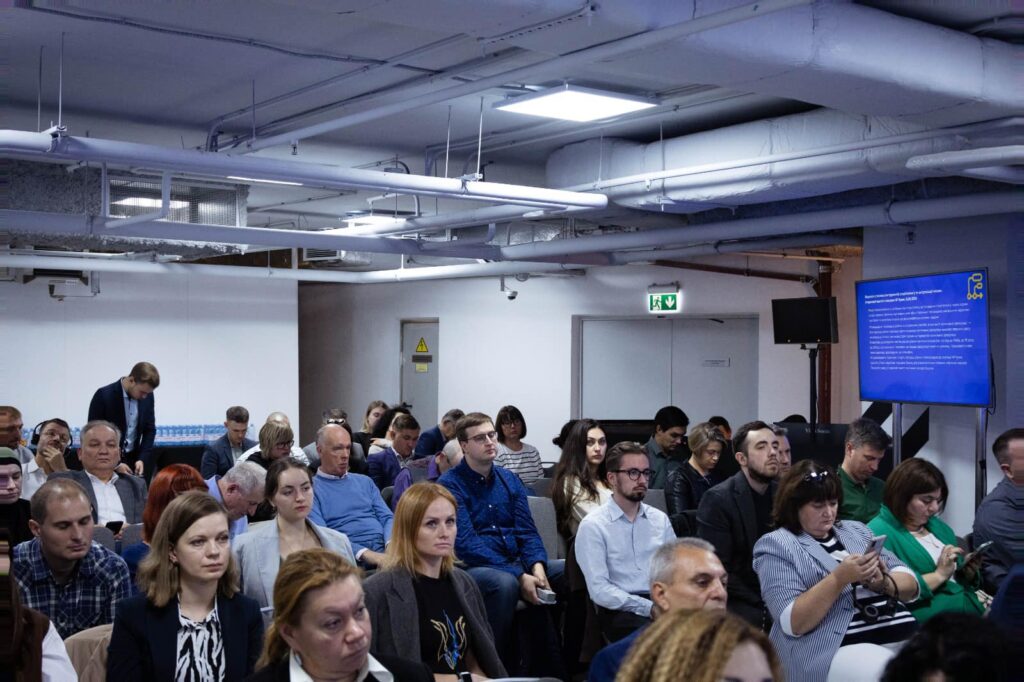
The presentation of the results of the activities of the Council on Cognitive De-occupation of Crimea, organized by the Mission and the Partnership Fund for a Resilient Ukraine, was held in Kyiv. The presentation was attended by more than 70 guests, including representatives of diplomatic missions, government agencies, civil society, human rights organizations, experts, and the media.
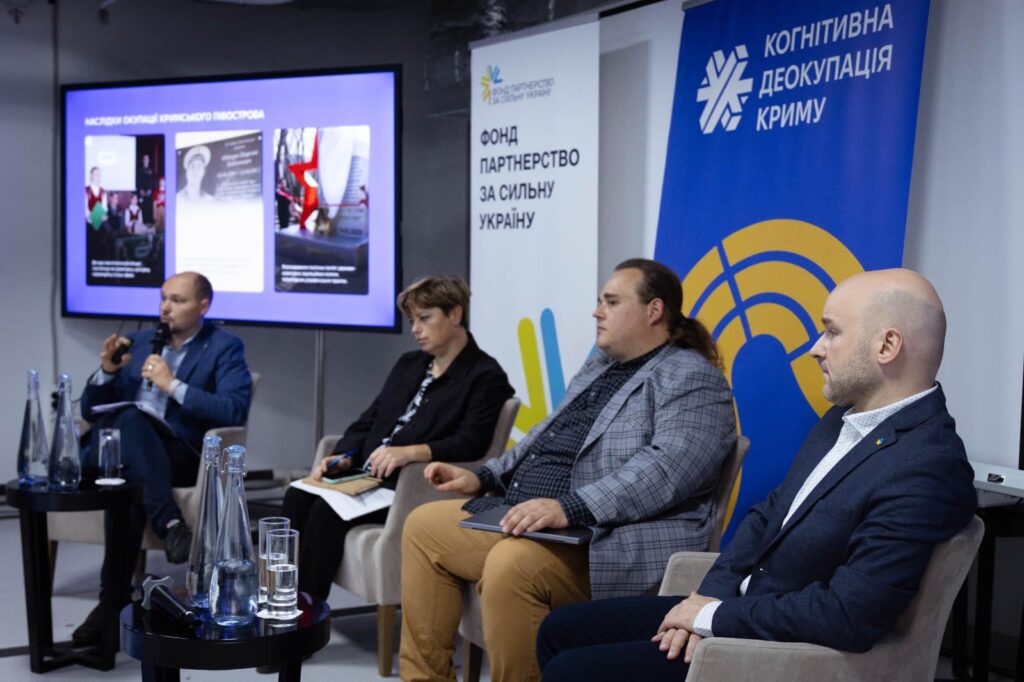
The presentation was attended by Permanent Representative Tamila Tasheva, Head of the Mission’s Information Department Yevhen Bondarenko, international security and stability expert Dmitri Teperik, Chairman of the Board of the Ukrainian Center for Independent Political Research and expert of the National Platform for Resilience and Social Cohesion Yuliia Tyshchenko, and historian and researcher Martin-Oleksandr Kyslyi.
The Council on the Cognitive De-occupation of Crimea was established under the Mission and focuses on developing practical steps and measures within the framework of the Strategy for Cognitive De-occupation of Crimea. The Council includes representatives from state authorities, MPs, academics, human rights activists, and communication specialists.
In her opening remarks, Permanent Representative Tamila Tasheva briefed the audience on the Council’s achievements, particularly the Mission’s efforts to promote the adoption of the Strategy at the state level.
“Over the year of our work, we have achieved significant results—if a year ago the term ‘cognitive de-occupation’ was hardly known and rarely used, today this approach is becoming increasingly widespread. We have developed several documents that outline the key aspects of cognitive de-occupation. In addition, there is a real demand from the expert community to scale up the experience of Crimea to other occupied territories,” emphasized Tamila Tasheva.
Tamila Tasheva also discussed specific initiatives being developed by the Council members, particularly in the areas of preserving national identity, language policy, cultural heritage, and dialogue development, which are crucial components of the Strategy for the Cognitive De-occupation of Crimea.
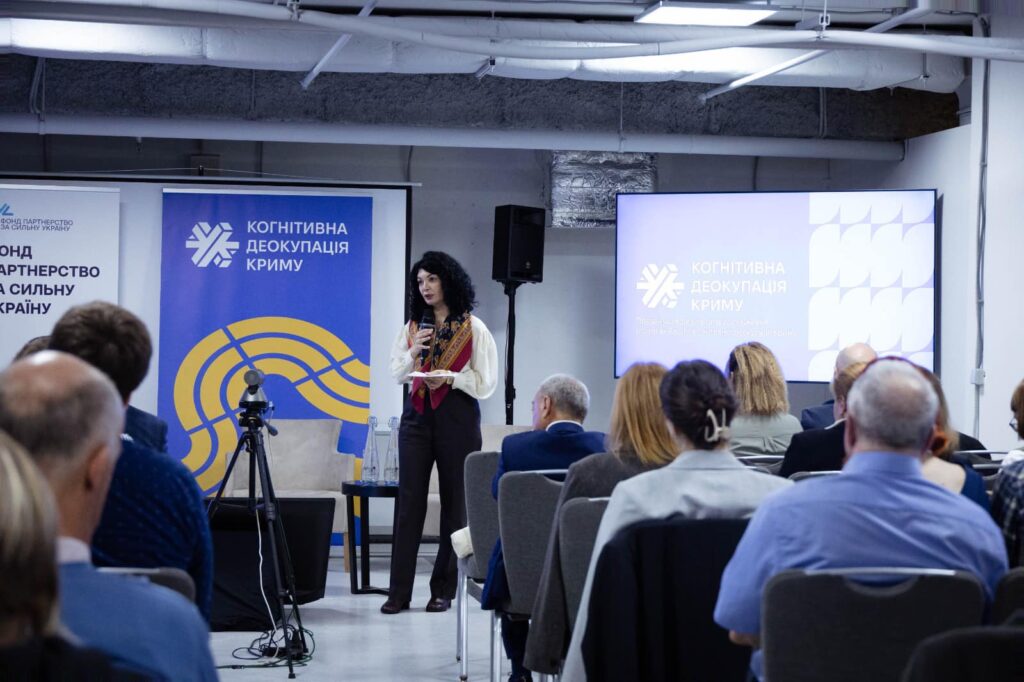
Head of the Information Department, Yevhen Bondarenko, highlighted that the goal of cognitive de-occupation efforts is to show the residents of Crimea the modern Ukrainian state, dismantling the Russian narratives that have been imposed on the peninsula over the 10 years of its occupation.
“All our work is to demonstrate the true history, to build modern narratives. First of all, it is necessary to restore the feeling of freedom, to ensure the possibility of exercising their rights, and to answer the question of our citizens: how will reintegration take place,” Yevhen Bondarenko said.
The participants were presented with the results of simulation exercises, workshops on cognitive de-occupation, interreligious dialogue, and other projects. The findings of a study conducted jointly with the Kyiv International Institute of Sociology, which explored the attitudes and sentiments of the Ukrainian population on various issues related to the cognitive de-occupation of Crimea, were also shared.
Dmitri Teperik, an international expert on security and stability, emphasized the importance of considering the power of imagination, metanarratives, and narrative theory and experimenting with future-oriented ideas to formulate an effective strategy to combat Russian narratives.
“We want to share Estonia’s experience, as we have already had a history of being under Russian occupation for centuries,” emphasized Dmitri Teperik.
Yuliia Tyshchenko, an expert from the National Platform for Resilience, spoke about the importance of memorialization and supporting national memory in the context of Crimea’s de-occupation. She also provided more details about the workshops for young people held at the Mission.
“No work should be done for the sake of work, no events for the sake of events—the history of Crimea should be told through the stories of different people,” Yuliia Tyshchenko emphasized.
Historian and researcher Martin-Oleksandr Kyslyi highlighted the deep-rooted influence of Russian narratives on the Crimean population.
“We need to understand that there is no precedent for this in world history, but this also gives our work great potential to introduce new approaches to the global community on how to deal with historical memory,” summarized Martin-Oleksandr Kyslyi.
The presentation highlighted the Council’s and the Mission’s planned steps within the framework of the Strategy for Cognitive De-occupation of Crimea, including the approval of the Strategy at the governmental level, and the development and implementation of legal acts on the de-occupation and reintegration of Crimea.
“There is a great demand for justice in society, and this requires changes to the state’s legal acts. Specifically, this applies to prosecution: Ukraine does not intend to prosecute individuals simply for living in temporarily occupied territory. Each person’s activities will be assessed individually to ensure fair decisions,” the Permanent Representative noted.
At the final stage of the presentation, a comprehensive study by the Kyiv International Institute of Sociology, conducted from July to September 2024 at the request of the Mission, was presented. The study combined both quantitative and qualitative approaches for an in-depth analysis of public attitudes toward Crimea. As part of a representative national survey, interviews were conducted with residents of government-controlled areas of Ukraine using the CATI method. Online focus groups were also held with Crimean Tatars and residents of various regions of Ukraine, along with in-depth interviews with experts. Special attention was given to the content analysis of more than 1,500 Telegram channels, where publications, comments, and reactions on the topic of Crimea were examined.
The Mission extends its gratitude to the Partnership Fund for a Resilient Ukraine, supported by the governments of Canada, Estonia, Finland, the Netherlands, Sweden, Switzerland, the United Kingdom, and the United States, for their systematic support of the Council on Cognitive De-occupation of Crimea. The Mission also thanks the participants of the presentation for their attention to the Crimea issue and for their significant contribution to the development and implementation of the complex and innovative initiative: the Strategy for the Cognitive De-occupation of Crimea.