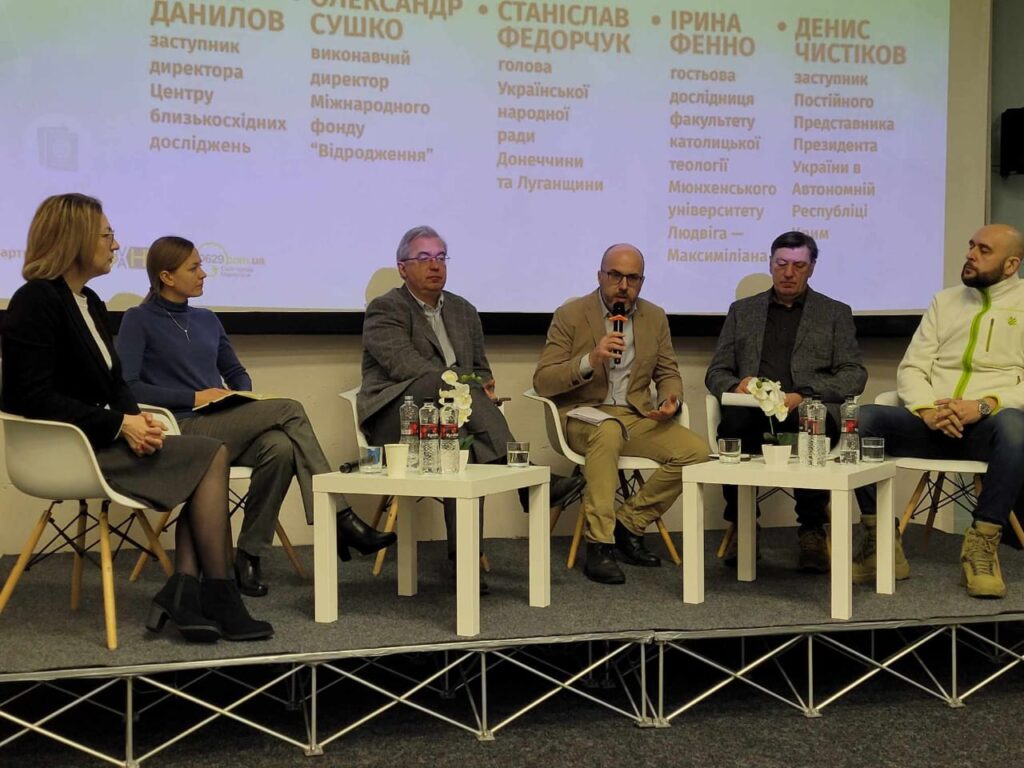
The Deputy Permanent Representative, Denys Chystikov, participated in the panel discussion “Intersectoral Collaboration Practices in Response to the Challenges of War and Occupation: Effective Formats and Risk Zones,” held as part of the UCU GLOBAL international conference “Solidarity Solutions and Cooperation for Building a Just Peace.”
The discussion also featured contributions from Oksana Kulakovska, Director of the UCU Analytical Center; Serhii Danylov, Deputy Director of the Middle East Center; Oleksandr Sushko, Executive Director of the International Renaissance Foundation; Stanislav Fedorchuk, Head of the Ukrainian People’s Council of Donetsk and Luhansk Regions; Iryna Fenno, Visiting Researcher at the Faculty of Catholic Theology of Ludwig Maximilian University, specializing in the Autonomous Republic of Crimea; and Oksana Kulakovska, Director of the UCU Analytical Center.
During his address, Deputy Permanent Representative Denys Chystikov highlighted the practices of intersectoral collaboration in response to the challenges of war and occupation, using examples from the work of the Mission. He emphasized several ongoing projects led by the Mission, including preparations for the Second Summit of the Crimea Platform, the Strategy for Crimea’s Post-De-occupation Recovery, and policies for restoring public administration and implementing cognitive de-occupation of the peninsula.
“With the onset of the full-scale invasion, our primary task was to place Crimea back on the mental map of Ukraine and the world. These efforts were carried out in close collaboration with state authorities and civil society,” Denys Chystikov emphasized.
He also stressed the significance of the Parliamentary Summits of the Crimea Platform, the first of which took place after the start of the full-scale invasion, highlighting their crucial role in demonstrating international support for the liberation of occupied Crimea. He pointed to international conferences like Crimea Global: Understanding Ukraine through the South, which brought together representatives from African, Asian, and Latin American countries.
Chystikov underscored the need to foster and support intersectoral cooperation in developing a network of Ukrainian Studies and Crimean Tatar Studies. This effort aims to disseminate truthful information about the history and culture of Ukraine and its Indigenous peoples, free from the influence of Russian or Eastern European narratives.
He also shared details of cultural projects undertaken by the Mission, including Letters to a Free Crimea and cultural-artistic exhibitions such as LOMYKAMIN. Women’s Resistance in Crimea and QIRIM İÇÜN / FOR CRIMEA.
In conclusion, the Deputy Permanent Representative underlined that despite the challenges and complexities of working in the field of de-occupation, the Mission’s activities are driven by the professionalism and dedication of its outstanding team, the valuable ideas they generate, and the unwavering faith and expectations of Ukrainian citizens regarding the liberation of temporarily occupied territories. These citizens, often at great personal risk, continue to provide crucial support and contribute to efforts to expedite the liberation of occupied lands.