Today, as part of the activities of the Council on the Cognitive De-occupation of Crimea, the Mission hosted the Second Interfaith Dialogue titled “Processes of De-occupation and Reintegration of the Autonomous Republic of Crimea and the City of Sevastopol: Key Challenges, Risks, and Ways to Overcome Them.” The event was initiated by the Mission and the State Service of Ukraine for Ethnopolitics and Freedom of Conscience.
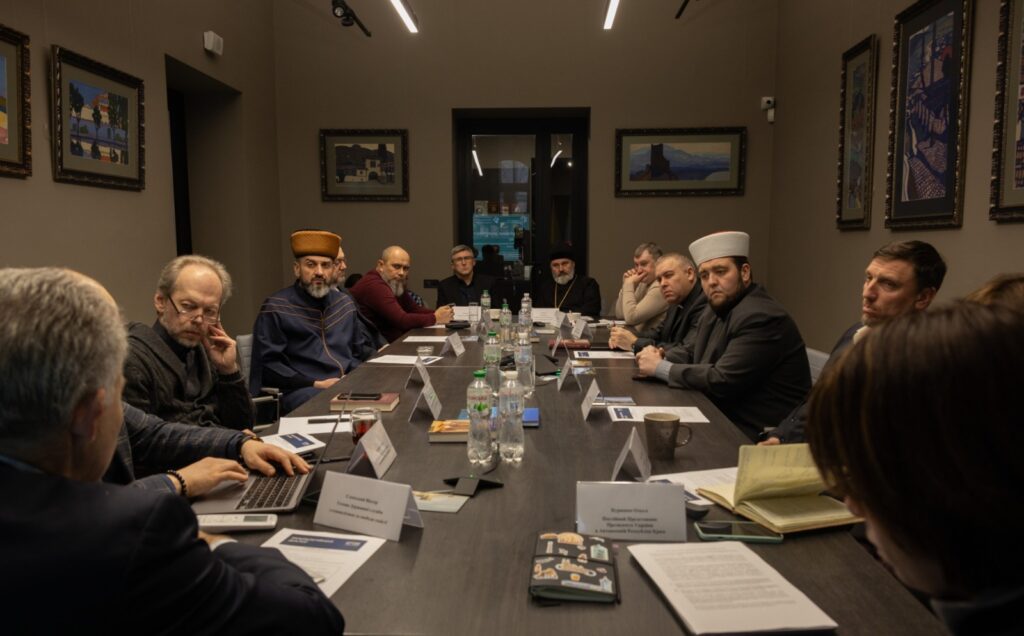
The event was attended by Permanent Representative Olha Kuryshko, Head of the State Service of Ukraine for Ethnopolitics and Freedom of Conscience Viktor Yelenskyi, and Yuliia Tyshchenko, an expert of the Council on the Cognitive De-occupation of Crimea and co-founder of the National Platform for Resilience and Cohesion. Also participating in the discussion were representatives of the Orthodox Church of Ukraine, the German Evangelical Lutheran Church of Ukraine, the All-Ukrainian Union of Churches of Evangelical Christians-Baptists, the Seventh-day Adventist Church, the Congress of Muslims of Ukraine, the Institute for Religious Freedom, the Spiritual Administration of Muslims of Ukraine Umma, the Spiritual Administration of Muslims of the Autonomous Republic of Crimea, the Department of External Relations of the Ukrainian Greek Catholic Church, the Department of Religious Freedom (Eurasia Mission), and the Open Orthodox University. The discussion was moderated by Yevhen Bondarenko, Head of the Information Department of the Mission.
The purpose of the meeting was to discuss the key aspects of Crimea’s de-occupation and reintegration, as well as to outline tasks for international advocacy and educational initiatives within the framework of cognitive de-occupation policies. Special attention was given to the role of religious institutions in the processes of restoring justice and fostering societal resilience in the context of Crimea’s de-occupation.
Representatives of religious organizations and experts participated in the discussion, highlighting religious persecution in temporarily occupied Crimea, the use of religion as a tool of Russian propaganda, and the need to document crimes committed by the occupation administration. Participants emphasized the importance of developing high-quality educational programs on Crimea’s religious and cultural heritage, expanding cooperation with international partners, and enhancing religious diplomacy. The issue of international advocacy was also raised—many religious leaders are already actively engaged abroad, and a proposal was made to analyze the calendar of international events for the year to strengthen engagement efforts.
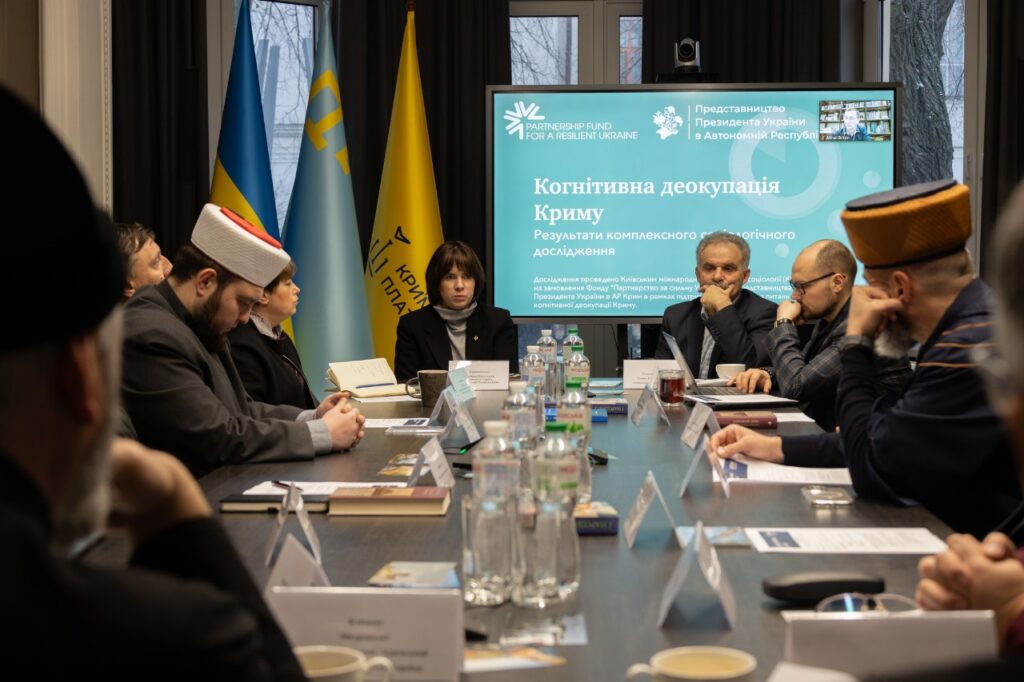
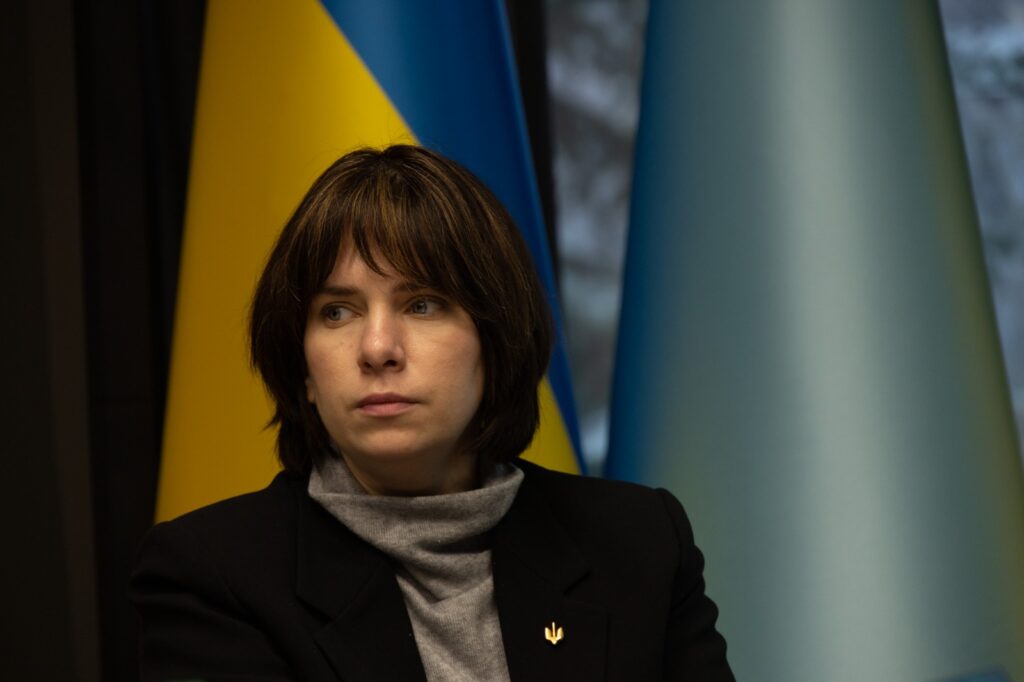
The event opened with welcoming remarks from Permanent Representative Olha Kuryshko and Head of the State Service for Ethnopolitics and Freedom of Conscience Viktor Yelenskyi.
In her speech, the Permanent Representative emphasized that religious persecution in Crimea has become systemic, with last year’s destruction of the last Ukrainian church in Yevpatoriia serving as further evidence of this policy. She underscored that the Mission is actively engaged in documenting repressions and involving the international community in responding to human rights violations in the occupied peninsula.
“The Mission continues to work on issues of religious persecution and the protection of believers’ rights in occupied Crimea. Last year, we witnessed the destruction of the last Ukrainian church in Yevpatoriia, yet another manifestation of the systemic suppression of religious freedoms. Today, we would like to present the findings of the KIIS study on the situation in Crimea and discuss concrete steps both within the peninsula and on the international stage. The aspect of cultural heritage is also crucial, as many religious sites hold historical and cultural significance. My call to you is for the consolidation of messages and the formation of a unified position,” stated Olha Kuryshko.
The Head of the State Service for Ethnopolitics and Freedom of Conscience emphasized the danger of becoming desensitized to war and the erasure of the distinction between aggressor and victim. He stressed that society must continue to remember the occupation of Crimea and the widespread human rights violations on the peninsula.
“One of the greatest threats today is the blurring of this war’s boundaries—its perception as an everyday reality, where the line between victim and aggressor fades. We must constantly remind the world that Crimea remains occupied, that human rights are systematically violated there, and that a great injustice is taking place. Crimes against freedom of conscience must not be silenced—they must be spoken about by clergy abroad and addressed by our international partners,” emphasized Viktor Yelenskyi.
Yuliia Tyshchenko, an expert of the Council on the Cognitive De-occupation of Crimea and co-founder of the National Platform for Resilience and Cohesion, presented the key findings of the “Cognitive De-occupation of Crimea” study, conducted in 2024 by the Kyiv International Institute of Sociology (KIIS) at the request of the Mission and the Partnership Fund for a Resilient Ukraine. The presentation focused on public opinion regarding Crimea and the ongoing processes on the peninsula. Yuliia Tyshchenko emphasized that there is a lack of information about Crimea in the Ukrainian media space, and the awareness level among residents of mainland Ukraine (including Crimean Tatars) about the peninsula remains low. This underscores the importance of increasing public discourse on Crimea.
Yevhen Bondarenko, Head of the Information Department of the Mission, presented the key developments in communication strategies aimed at effectively conveying the real situation in temporarily occupied Crimea to both Ukrainian and international audiences. He introduced two strategic documents, tailored for various audiences, including European states, as well as countries in Africa, Asia, and South America. These materials are structured into sections covering aspects such as attitudes toward Crimea’s residents, Ukraine’s political stance, and legislative mechanisms. Yevhen Bondarenko also noted that Russia systematically uses religious figures from occupied territories as a propaganda tool, creating the illusion that conditions have supposedly improved after the occupation. These tactics have been observed for several years, and based on assessments, Russia is expected to intensify its efforts in this area. This makes it crucial to actively engage with religious communities to expose the true reality of repression, persecution, and violations of religious freedoms in Crimea.
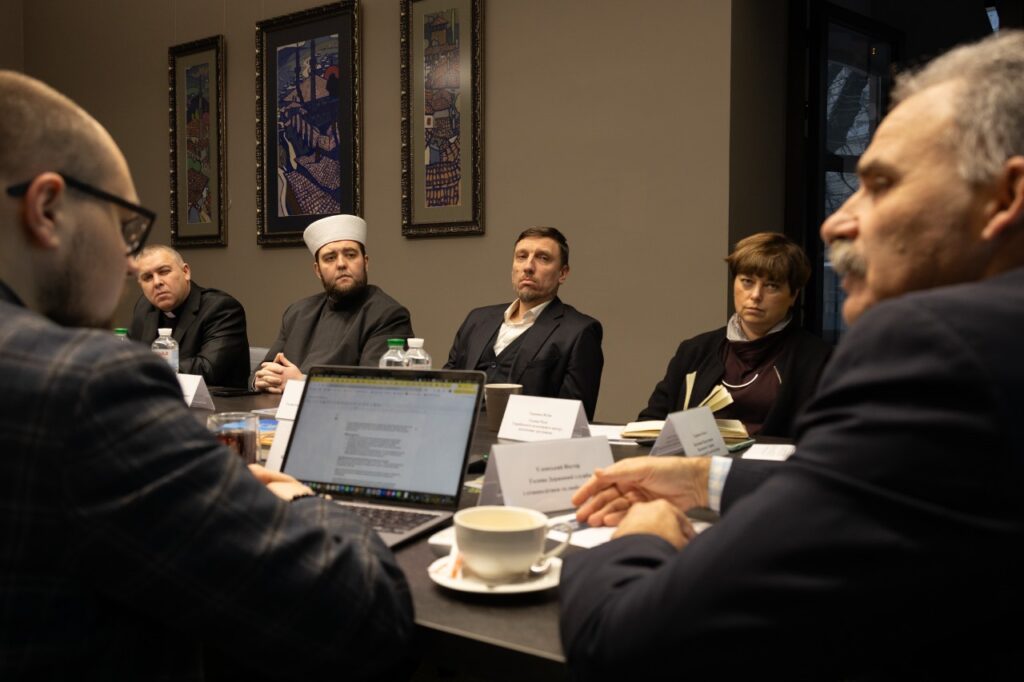
The meeting participants agreed to collaborate across various areas within Ukraine, including regular consultations and feedback on communication messages and narratives related to the cognitive de-occupation of Crimea, developed by the Mission. Additionally, a decision was made to organize a series of joint events aimed at uniting the efforts of churches and religious organizations in addressing cognitive de-occupation and their role in broader societal processes.
Permanent Representative Olha Kuryshko and Head of the State Service for Ethnopolitics and Freedom of Conscience Viktor Yelenskyi emphasized that the Mission and SSEFC are ready to serve as reliable partners in this joint effort.
We express our gratitude to the representatives of churches and religious communities for their cooperation and active participation in the Interfaith Dialogue. These meetings will be held regularly, and the date of the next session will be announced soon.