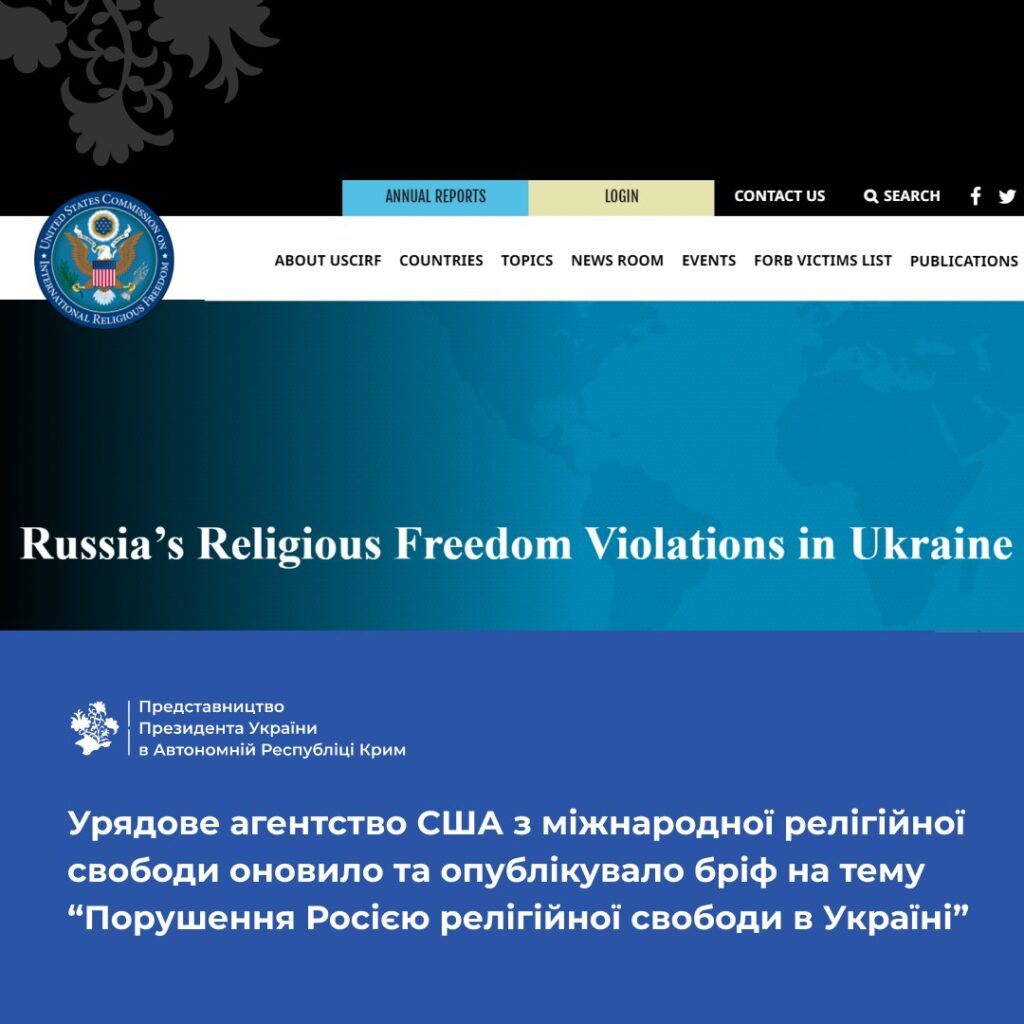
The United States Commission on International Religious Freedom has updated and published a brief on “Russia’s Violations of Religious Freedom in Ukraine”, information for which was also provided by the Mission.
The brief refers to the intensification of repression against religious communities by Russia after the beginning of the full-scale invasion: destruction, confiscation and theft of churches and mosques, illegal criminal cases against Crimean Muslims and Jehovah’s Witnesses, propaganda and accusations of extremism and terrorism against certain religious groups that have been quietly existing and practicing their faith in Ukraine.
Below is a translation of the part about violations of religious freedom in the occupied Crimea:
Since the occupation, Russian de-facto authorities have enforced Russia’s religiously repressive legal system that punishes independent religious activities and targets disfavored religious groups. All religious groups in newly Russian-occupied territories had to re-register
in accordance with Russian-imposed requirements. Authorities denied legal registration to several religious organizations and coerced others to recognize their legitimacy to gain registration. When the deadline for re-registration in Crimea passed in January 2016, only about 400 religious organizations had gained Russian legal status as opposed to the 1,546 recognized in Crimea under Ukrainian law prior to occupation. As of September 2022, Russian authorities in Crimea have registered more than 900 religious communities.
Upon registration, religious communities must adhere to Russian law which prohibits certain forms of religious activities and speech. Courts in occupied Crimea have fined several religious communities and members for illegal missionary activities, which include preaching, praying, disseminating religious materials, and even answering questions about religion outside of officially designated sites. In May 2022, a Crimean Tatar Muslim was fined $250 (20,000 Russian rubles) for leading prayer at a mosque without being a registered member of the community, and in August, a court in Yalta fined
a Roman Catholic priest $374 (30,000 Russian rubles) for failing to put his parish’s full legal name on material posted on social media.
Russia’s extremism law grants courts broad autonomy to determine whether literature or groups are “extremist,” therefore subjecting them to various legal sanctions including literature bans, liquidation, financial blacklisting, or imprisonment of members who engage in the organization’s activities. The law fails to clearly define “extremism,” and the use of or advocacy for violence is not a prerequisite to be declared extremist, paving the way for authorities to prosecute virtually any activity or speech they consider problematic.
Since the Russian Supreme Court declared Jehovah’s Witnesses extremist in 2017, Crimean Jehovah’s Witnesses have faced unjust prosecution for their peaceful religious activities. In December 2022, a court in Armyansk sentenced two Jehovah’s Witnesses to six years in prison for discussing the Bible over Zoom among other peaceful religious activities. In February 2023, the Yalta City Court sentenced three Jehovah’s Witnesses to between six and six-and-a-half years in prison and another Jehovah’s Witness to three years’ suspended imprisonment for their religious beliefs. As of March, Russian de-facto courts in occupied Crimea have sentenced 12 Jehovah’s Witnesses to imprisonment and two to suspended imprisonment, with five still under investigation.
Authorities in Crimea have targeted the OCU since it gained autocephaly in 2019, including arresting its archbishop and ordering the demolition of one of its churches. Most recently in May, Russian authorities seized the OCU Cathedral of Saints Volodymyr and Olha in Simferopol and transferred it to the Russian Orthodox Church.
Crimean Tatars, who fiercely oppose Russia’s purported annexation of Crimea, have faced some of the harshest repression. Russian officials have dismantled Crimean Tatar institutions, subjected the community and its allies to harassment and intimidation, and arrested dozens of Crimean Tatar activists, journalists, and other civil society actors on the basis of their religious identity, religious activity, or alleged affiliation with Hizb-ut- Tahrir (HT), which is legal in Ukraine but banned in Russia. Since the Russian Supreme Court declared HT a terrorist organization in 2003, Muslims in Russia accused of belonging to HT have faced unsubstantiated terrorism and other charges related to their religious affiliation or activities, despite no evidence the defendants participated in, called for, or planned violence.
In February 2022, Federal Security Service (FSB) officers searched the homes of four Crimean Tatar activists and detained them for alleged HT activities, which included organizing and participating in meetings and discussing religion and politics. The Southern Military District Court subsequently sentenced Marlen Mustafayev to 17 years’ imprisonment in November, Ametkhan Abdulvapov to ten years and six months’ imprisonment in March, Ernest Seytosmanov to 18 years’ imprisonment in May, and Ansar Osmanov to 20 years’ imprisonment in June.
Over the course of 2022 and early 2023, the Southern District Military Court sentenced a group of 20 Crimean Tatar activists who were arrested together in 2019 to prison terms ranging from 12 to 19 years
for alleged HT affiliation. At the time of their arrests, authorities reportedly planted and subsequently
“found” HT materials during searches of their homes. Those sentenced include Remzi Bakirov, Riza Izetov, Farkhod Bazarov, Raim Ayvazov, Shaban Umerov, Tofik Abdulgaziyev, Vladlen Abduklkadyrov, Izzet Abdullayev, Medzhit Abdurakhmanov, Bilyal Adilov, Enver Ametov, Ruslan Suleimanov, Yashar Muyedinov, Rustem Sheikhaliev, Osman Arifmemetov, Alim Karimov, Servet Gaziyev, Erfan Osmanov, Seiran Murtaza, and Dzhemil Gafarov.
In January, the Southern Military District Court sentenced Crimean Tatar cleric and activist Raif Fevziyev to 17 years in prison, and in May, the court sentenced Dzhebbar Bekirov to 17 years in prison and Zavur Abdullayev, Rustem Murasov, and Rustem Tairov to 12 years in prison each. All five had been arrested in August 2021 and accused of being involved in HT. Prosecutors used recordings of the defendants discussing religious issues as evidence during trial, with at least one of the recordings dating back to December 2015.
In May, the Southern Military District Court sentenced Oleksandr Sizikov, who is legally blind, to 17 years in prison and Seiran Khairedinov and Alim Sufianov to 12 years in prison each for alleged HT activities, which included possessing religious literature and discussing religion and politics. Authorities had originally detained the three in July 2020. Sizikov remains under house arrest pending his appeal.
Imprisoned Crimean Tatars reported medical neglect, being served food violating their religious dietary requirements, Qur’an confiscations, and inhumane living conditions, including rat-infested cells and a lack of access to beds, clean water, and sanitary toilet facilities. In February, Dzhemil Gafarov died in prison after experiencing chest pain, difficulty breathing, and severe headaches. Prison authorities rejected his January request to transfer to a hospital and had allegedly denied him medical care repeatedly over the years, despite his preexisting health conditions. In April, authorities took into custody Amet Suleymanov to begin serving his sentence, despite his serious heart issues. Authorities had placed Suleymanov under house arrest in March 2020 after accusing him of HT membership, and in October 2021, the Southern Military District Court sentenced him to 12 years in prison.
Read the full brief in the original language: https://cutt.ly/LwiPIQTP